
What does a successful retirement fund really look like?
In an article published by the Institute of Retirement Funds Africa (IRFA), Mentenova Senior Investment Consultant Mzovuyo Nyamela challenges the industry to look beyond investment returns and asset growth as the primary measures of success – and focus instead on the outcomes those investments ultimately create for members.
Using a real-world member journey, Mzovuyo explores how understanding retirement liabilities at an individual level, and acting on the levers available to members and funds, can materially change projected retirement outcomes. His argument is simple but important: the true measure of investment success is not only how a portfolio performs, but whether that performance helps people achieve the income they need to sustain their lives in retirement.
Read the full article below or in the IRFA publication, to explore what moving from returns to real outcomes could mean for retirement funds and their members.
Article originally published by the IRFA
For most South Africans, the vision of a good retirement is unattainable. But is it really? For more than a decade, the retirement and investment industry has been grappling with a harsh reality: only 6% of South Africans are able to retire comfortably. This is with investment experts in the room guiding clients in how to make sound investment management decisions.
The industry looks healthy. The 2023 FSCA Retirement Funds Statistical Report showed that pension funds in South Africa grew their asset base from R5.56 trillion in 2022 to R5.84 trillion in 2023. Among the reasons for this growth were the expansion of total fund membership from 17.3 million in 2022 to 18.6 million in 2023, and positive investment returns. Although strong fund participation and asset growth are the right way to go, do they improve the outcomes for pension fund members?
In my younger years, I cannot count the number of times that I sat in investment conferences and attended webinars in which the success of a pension fund and (even worse) the fund manager was defined in terms of asset growth and investment performance. Is this how we should be gauging the success of a retirement fund? Are investment returns and asset growth the bottom line that we should be focusing on?
While outcomes-based investing is a common strategy used in the retirement and investment industry to steer decision-making and objective-setting, the fact that only 6% of South Africans can retire in comfort suggests that a great deal of investment activity is missing the mark – by a wide margin. This begs the question: are pension fund members’ investment decisions designed to deliver the outcomes that the investment professionals talk about? What, ultimately, makes a pension fund successful, and how does one measure that success?
Before I try to answer these questions, let me provide some context. The South African retirement industry has a long history, with its formal ‘modern’ structure coming into being with the passing of the Pension Funds Act of 1956. As a regulated industry, therefore, it is roughly 70 years old. It is very sad and indeed unacceptable that, after 70 years of offering all sorts of investment advice and solutions, so few people – from all walks of life – can retire confidently and maintain a comfortable lifestyle.
Let us look at this from an industry perspective. Imagine that you are reading this article as a trustee of a mid-sized pension fund with approximately 1000 members. You have attended innumerable quarterly meetings to discuss operational and investment fund matters, you have regularly reviewed and re-adjusted the fund’s asset allocation or strategy, and you have appointed and/or replaced various service providers that support you and your fund. And despite all this activity, only 60 of your 1000 members are likely to retire in the way that they had hoped, with dignity.
Something is missing from the equation – perhaps the point of it all? The portfolio may be outperforming benchmarks and assets may be growing. But the real question to ask is: Are members able to sustain themselves and their families with a decent level of income during retirement? We need to start asking the experts in the room. After all, as Albert Einstein said, “Insanity is doing the same thing over and over again and expecting different results.”
You cannot construct an investment solution at the total fund level unless it is understood at the member level. The retirement problem rests with the member, who is the beneficiary, along with their dependents. Therefore, investment objectives must revolve around the income that the member needs in order to sustain their working-life standard of living into retirement. This is the very essence of outcomes-based investing.
Let me share a true story of how we construct investment solutions at Mentenova and how we measure success for our clients.
Member A – whom I shall anonymously call Mr Khumalo – is a vehicle operator at a steel factory shop. He lives with his wife and grandchild. His mother, 77, is also under his financial care. Mr Khumalo does not have any other retirement savings outside the retirement fund offered by his employer. Sound familiar? This is the reality faced by large numbers of households in South Africa.
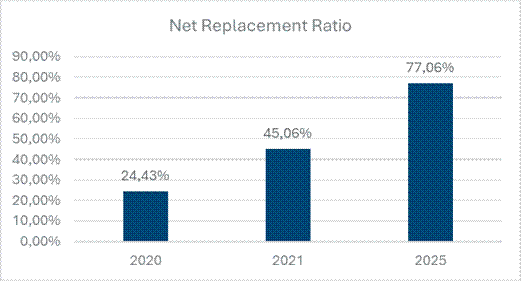
Mentenova first engaged with Mr Khumalo in 2020, in a member group session. Using our proprietary member-focused liability system, we projected his individual replacement income at retirement to be 24.43% of his final salary. This means that if Mr Khumalo earns R10 000 per month as his final salary the day before he retires, he would earn only R2 443 from his retirement annuity. What this infers is that Mr Khumalo must reduce his liabilities and expenses on the day he retires by approximately 76% to adjust his lifestyle to this new level of income. As investment consultants, we must ask ourselves: how does a breadwinner, whose wife, granddaughter and mother depend on him, reduce the household standard of living by 76%? How does he explain this to his wife and mother? We can only imagine the psychological blow that this would have.
Retirement industry experts have done well in their publishing of average replacement ratios. But what these numbers mean for individual households, given their particular circumstances, are rarely unpacked. In Mr Khumalo’s case, it means that, upon retirement, he will be facing an extremely worrying outcome – his financial wherewithal will suddenly shrink to just under a quarter of what it used to be when he was working.
Knowing and publishing likely outcomes does not improve outcomes, which is why we do not stop there with our clients – even though retirement is, strictly speaking, a household matter. As Henry Ford famously said, “Don’t find fault, find a remedy.”
We gave Mr Khumalo three simple evidence-based tools within the retirement fund structure to consider, to help him avert the outcome that he was facing: (1) invest in a portfolio with a higher income target, (2) increase his contribution, and/or (3) defer his retirement to the age of 65 from 60. The latter related to a proposed change to the fund rules, which – in the view of the Management Committee – was likely to improve the average fund outcome.
Many employers claim that their employees cannot afford to increase their contributions, yet the same employees can afford an extra R100 for sports betting every weekend! For us at Mentenova, the true measure of success is how we improve the retirement outcomes for South African households. Our market analyses, investment advice and solutions, and fund management are all aligned to this mission.
Following a comprehensive analysis that tracked each proposed change and the impact it would have on his retirement outcome, Mr Khumalo was advised to increase his contributions by 0.5% and extend his retirement age by five years to 65. The compounded effect of these actions almost doubled his projected retirement income for 2021 to 45.06%.
Source: Mentenova PlanMyBenefits
These two levers were activated at a time when the JSE Capped All Share declined by 16.7% in the first three months of 2020, when we were all bracing ourselves for a new type of existence defined by masks, lockdowns and curfews. Scary times – yes. But not scary enough to backtrack on making intelligent investment decisions.
Between 2021 and 2025, by shifting his definition of risk from risk of volatility to risk of losing purchasing power, Mr Khumalo switched from a stable growth portfolio to a wealth-building portfolio, and further increased his contributions by 2.5%. These levers improved his outcome – from R4 506 to R7 706 – which meant that at the end of 2025, he was projected to be able to maintain his standard of living when he retires. This would allow a much easier financial transition from employment to retirement and put a smile on his face as he could continue to care for his family with confidence and dignity.
This is what investing for retirement means. At the end of the day, we see success as the impact that we have on people’s lives. How many Mr Khumalos do you have in your pension fund? What measures do you have in place to track and improve their retirement income liability?
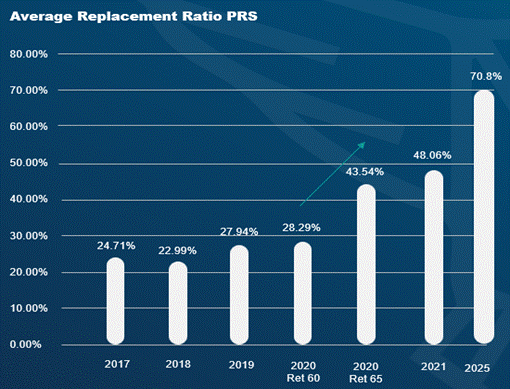
Below is the total fund improvement after all our engagements with the Management Committee and members of the fund that Mr Khumalo belongs to:
On countless occasions, we have walked into boardrooms and presented this approach, only to be old by Mancos or benefit consultants that this would be an impossible task for their employees. The problems seem endless and there are always reasons why things can’t be done.
But this should not be the focus. Consultants are not rewarded for sounding the alarm; they are rewarded for advising and providing solutions in an increasingly unpredictable and volatile environment. How many times do we convince ourselves that we’re too busy to go to the gym, to prepare proper meals, to get enough sleep? The problem is not time. It is how and where we allocate the time that we have, and how we prioritise. The same principle applies to income. It is how we allocate our money that matters.
Prudent retirement planning requires a particular mindset – where the priority is not indulging in distracting, short-term gratification or postponing one’s well-being. Rather, it is increasing contributions, being invested in the right risk-profiled portfolio and, when there is no longer an employer, being able to retire comfortably.
Is it possible for the average South African to earn a good retirement income? We certainly think so. Ask Mr Khumalo.
